Batching Cocktails for Bars: Method, Costs and Service
How to batch cocktails in your bar without losing quality: what to batch, dilution, costs, labelling and prep organisation so service runs faster.
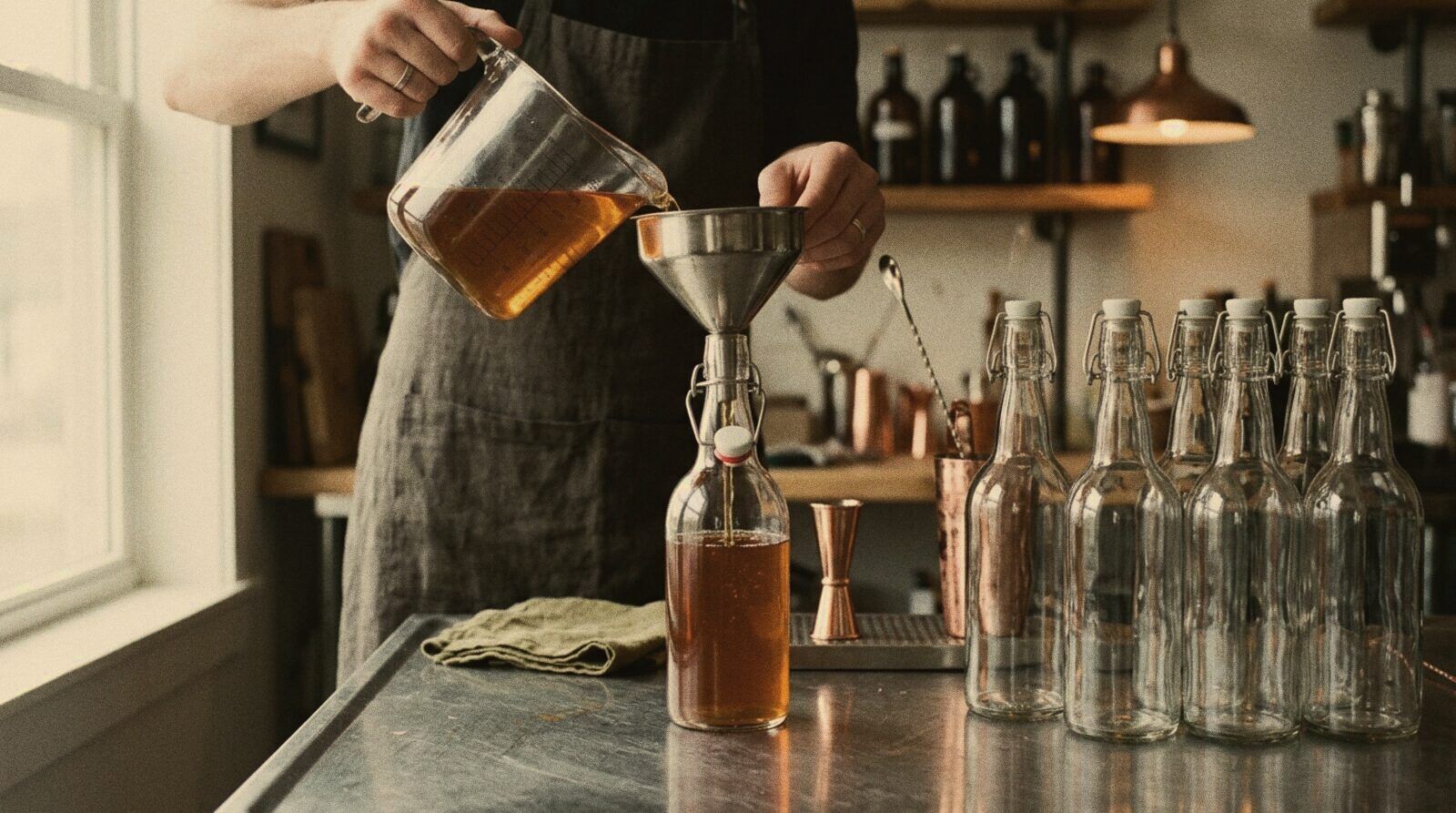
Batching cocktails is not about doing less work. It is about doing the work when it suits you. If your bar jams up at ten at night, it is probably not because your team is slow, but because you are doing in the middle of service things that could have been done at five in the afternoon.
You will not find a recipe or a lab-style technical tutorial here; there are very good resources from other colleagues for that. What I want to show you is how batching looks from an operational point of view: what you gain, what you risk, how to organise it and how to know whether it pays for itself.
What batching is in cocktail making (and what it is not)
Batching means preparing in advance, and in quantity, the part of a cocktail that can be mixed beforehand. Then, during service, you only finish it: serve it over ice, shake or stir what needs shaking or stirring, garnish. You will also hear it called pre-batching, and the result pre-batched cocktails.
It is not:
- An industrial cocktail. The aim is not to cut costs at the expense of quality.
- A shortcut for every menu. Some cocktails simply do not lend themselves to it.
- Something you improvise. A batch with no spec sheet, no label and no control is guaranteed waste.
Why batch: what changes in the operation
These are the four benefits bar owners really notice:
| Benefit | What it means at the bar |
|---|---|
| Speed | Fewer steps per cocktail at peak times; the guest waits less |
| Consistency | The same measure and the same balance, whoever makes it |
| Cost control | Fewer spills, more reliable measures and better tracking of consumption |
| Order | Mise en place is concentrated in one part of the day and does not interrupt service |
And the costs you do not see at first:
- Prep time outside service, which has to be paid for and planned.
- Equipment: suitable containers, fridge space, labels.
- Risk of waste if you prep more than you sell.
- Training: the team must know what each prep is and how to finish it.
What to batch and what to leave for the order
The right question is not “can I batch this?” but “do I gain anything by batching it?”. A practical rule of thumb:
| Candidate | Batch | To order |
|---|---|---|
| Ordered a lot at peak times | Yes | |
| Stable base, few fresh ingredients | Yes | |
| Recipe with several repetitive steps | Yes | |
| Ordered rarely or irregularly | Yes | |
| Relies on freshly squeezed fruit, foam or fizz | Yes, or just the base | |
| Its charm is in the final gesture in front of the guest | Just the base | Yes |
The usual approach is to batch the base and finish to order whatever gives freshness or theatre. That way you sacrifice neither speed nor character. Batching pays off most in high-volume bars and at events, a setting I work on in events and brands.
Dilution: the concept most people forget
When you shake or stir a cocktail with ice, some of the ice melts and the drink gains water. That water is not an accident: it is part of the drink’s balance, its temperature and its flavour. It is a basic concept in cocktail making.
In a batch, if you store it without ice, that water is not there. The usual answer is to add it back in a calculated way when you make the mix, and to check the result against the cocktail made to order. A few things are worth being clear about:
- There is no universal percentage. It depends on the recipe, the ice, the technique and what you are after.
- You validate it by tasting. Do it with the traditionally made cocktail next to it, at the same temperature, and adjust.
- You write it on the spec sheet. If the dilution is not recorded, the next person to make the batch will do it differently.
- You measure it. Use measures, not your eye.
I am not giving you figures here because every bar and every cocktail needs its own. If you would like us to work them out together for your menu, that is part of the work in drinks development.
Food safety, shelf life and labelling
A batch is a prep that will wait hours, or longer, before being served. That means it has to go into your food safety system like any other preparation.
My advice, to be on the safe side: do not copy storage times from the internet or from another bar. The shelf life of a prep depends on its ingredients (alcohol, acidity, dairy, fresh juices), on how it is stored and on how it is handled. That figure should be set in your HACCP-based food safety plan (in Spain, your plan de autocontrol), with your food safety adviser and, where appropriate, following the guidance of the health authority of your region.
What I can tell you from the operational side is how to avoid the most common mistakes:
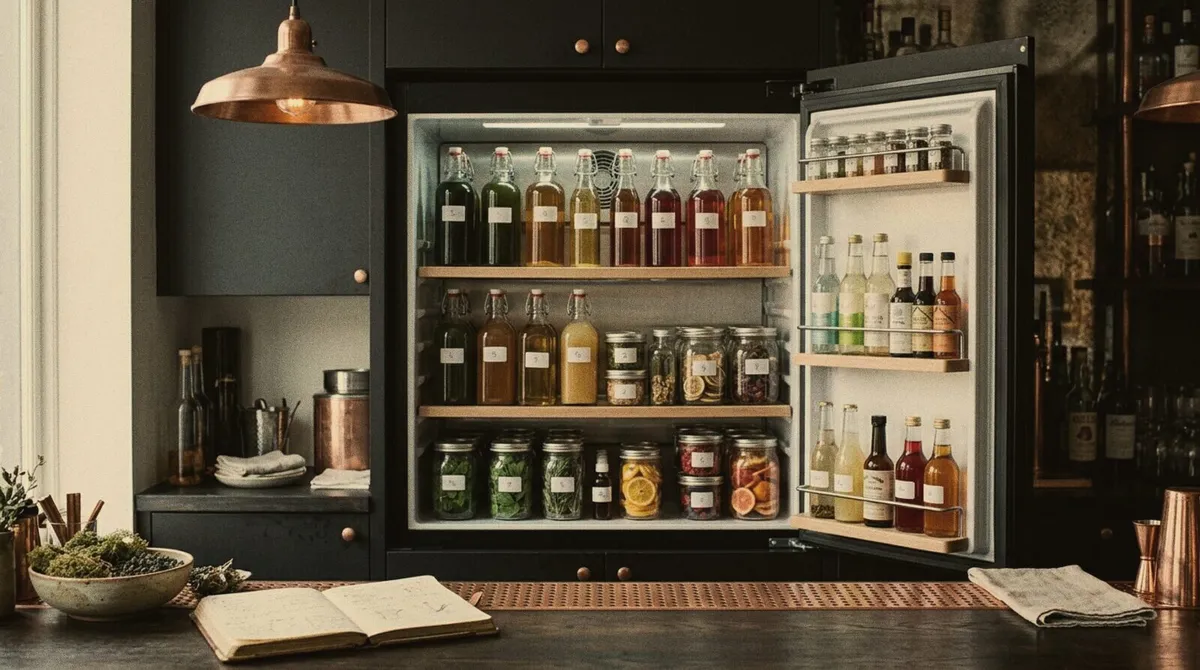
- Label everything. Name of the prep, date and time it was made, who made it and use-by date according to your documented criteria.
- State the allergens if the prep contains any. In Spain, the allergen rules that apply to food businesses come from Regulation (EU) 1169/2011, so check with your adviser how they apply to your preps.
- Use clean, closed containers, dedicated and clearly identified.
- Apply first in, first out.
- Bin what expires. It is cheaper to throw away a prep than to deal with a problem with a guest.
- Record what you discard. It is the figure that tells you whether you are prepping too much.
How much money it makes you (and loses you)
Batching is justified with numbers, not intuition. This is an analysis template; the figures are an illustrative example, not real data from any venue:
| Item | Example |
|---|---|
| Cocktails served at peak time (example) | 40 |
| Seconds saved per cocktail with batching (example) | 20 |
| Total time recovered in that window | 40 × 20 s = 800 s, about 13 minutes |
| Weekly waste of preps (example) | 2 bottles |
| Cost of that waste | whatever your ingredients cost, to be calculated with your costing sheet |
With that outline you can answer three questions: how much time do I gain, what do I lose in waste, and what is that time worth in your venue, in extra cocktails served or in guests who do not walk away because of the wait?
To work out the cost of each prep without fudging, you need a good costing sheet. I explain it in this guide to cocktail costing. And if you would like an outside view of your bar costs, have a look at the bar audit and cost control service.
How to organise batching day to day
Batching fails through disorganisation, almost never through technique. A minimal system:
- One spec sheet per prep, with measures, dilution, method, yield and the person responsible (I explain how to build them in cocktail spec sheets).
- A prep schedule: what gets made, on which day and by whom.
- A forecast calculation based on real sales, not on optimism.
- A fixed time of day to do it, which does not clash with service.
- A waste log that you review every week.
- A tasting check before opening: every day, someone tastes the prep.
In a bar with a lab like Stillroom’s, mise en place is part of the craft and is treated with the same rigour as service. That discipline is what makes any technique, batching included, work.

Common mistakes when starting out
- Batching the whole menu at once. Start with two or three of your best sellers.
- Not testing against the original. The batch cannot be “similar”; it has to be just as good.
- Prepping without sales data. It is the main cause of waste.
- Half-hearted labelling. An incomplete label is worse than none, because it gives a false sense of security.
- Not training the team. If everyone finishes the cocktail their own way, you lose the consistency you were after.
- Not reviewing. A batch is measured, corrected and updated.
Is it worth it in your bar?
Before buying anything, run a week of trials with two cocktails and a simple log: service times, waste, comments from the team and from guests. If the data improves, you scale up. If not, you have spent very little to find out.
And remember that batching is a tool, not a philosophy. There are excellent bars that use it a lot and others that barely use it; what matters is that the decision comes from your numbers and your menu. If you would like us to review it together, from operations and cost to training your team, tell me about your case on the cordials and ferments consulting page or write to me via contact.
Topics: batching cocktails · pre-batched cocktails · bar operations · speed of service
Frequently asked questions
Are batched cocktails the same as bottled cocktails?
Not exactly. A batch is a base prepared in advance and finished at the bar (over ice, stirred or shaken, garnished), while a bottled cocktail is served exactly as it comes out of the bottle. The production method is the same, but bottled cocktails need even tighter control of dilution, temperature and shelf life, because nobody corrects them before they are served.
Can you batch a cocktail that contains citrus juice?
You can, but it is the most delicate part: freshly squeezed juice loses its freshness quickly. Many bars batch the spirit, liqueurs and syrups and add the citrus to order, or squeeze it the same day. If you include it, validate the result with tastings and set its shelf life in your food safety plan.
Is batching worth it for events and high-volume bars?
That is where it pays off most: when you have to serve a lot of identical drinks in a short time, preparing the bases beforehand lets you keep quality without multiplying staff. The key is to forecast properly so you do not end up with leftover product.
What containers should you use to store a batch?
Clean, food-grade bottles or containers with an airtight seal, sized to what you use in one service, so you are not opening and closing the same container for days. Clear ones help you check the level and the condition of the prep.
Does batching make each cocktail cheaper?
It does not change the cost of the ingredients, but it reduces spills and measuring errors, and it turns service time into prep time. In exchange, it adds production hours and the risk of waste if you prep too much, so the saving is only real if you measure it.
Want to bring this to your bar?
Cordials and ferments
I build your prep programme: ferments, cordials, clarified drinks and batching, with spec sheets, shelf life and hands-on training.
Bar audit and cost control
I come to your bar during live service, review your menu, costings and waste, and leave you a prioritised 90-day plan.