Cocktail Costing: Cost and Price Every Drink Right
Learn how to cost your cocktails: real cost with waste, ice and garnish, menu price and margin, with a worked example step by step. Built for bar owners.
Cocktail costing is the sheet that tells you, drink by drink, what it really costs you to serve it and what price you need to charge for the bar to make money. It sounds like an office job. In fact it is the difference between a bar that is full and leaves no margin and a bar that is full and profitable.
I have seen the bar from both sides: as a bartender, with three years behind the bar at Baldoria in Madrid, and as founder and creative director of Stillroom, the gastronomic cocktail bar on Calle Moreto. On the owner’s side, margin stops being an abstraction. Here I walk you through the method, with none of my own recipes or prices: the numbers in this article are examples.
What cocktail costing is, and why drinks are costed differently
Costing, in hospitality, is working out the cost of one unit for sale from its ingredients. If you search for recipe costing online, nearly everything you find is about kitchen dishes: kilos, grams, trim waste on meat and fish. That is a useful base, but a bar has extra elements to account for.
In a cocktail the cost is not only in the bottle:
- Ice: it goes into almost every drink and almost nobody counts it.
- Garnish: citrus, herbs, edible flowers, dehydrated fruit.
- House preps: syrups, cordials, infusions or ferments have a cost of their own, and you need to cost them before they go into the glass.
- Spillage and waste when pouring: no team pours exactly to the millilitre for eight hours in a row.
- Consumables: straw, coaster, napkin, sometimes broken glassware.
- Open bottles: product left open is money tied up.
If you ignore these lines, your real cost is higher than the one on the sheet. And a price built on a cost that is not the real one is a margin that does not exist.
The three building blocks of costing: unit cost, quantity and waste
Before the example, the formulas. There are only a few, and it helps to have them clear:
- Cost per millilitre (or unit) = purchase price ÷ usable content.
- Cost of the ingredient in the drink = cost per millilitre × quantity in the drink.
- Cost of the drink before waste = sum of the costs of all the ingredients.
- Cost of the drink with waste = cost before waste ÷ (1 − waste percentage).
- Selling price before VAT = cost with waste ÷ target cost percentage.
- Selling price with VAT = price before VAT × (1 + VAT rate).
- Gross margin per drink = price before VAT − cost with waste.
One important point about step 4: divide by (1 − waste), do not multiply by (1 + waste). If you lose 5% of the product, you only get to use 95%, so the cost of what you actually serve is the cost ÷ 0.95.
A cocktail costing example, step by step
Warning: every figure in this table is made up to illustrate the calculation. They do not correspond to any cocktail or any price at Stillroom or at any other venue. Use the logic, not the numbers.
Let’s take a generic rum, lime and syrup cocktail.
| Ingredient | Purchase (example) | Unit cost (example) | Quantity in the drink | Cost in the drink |
|---|---|---|---|---|
| Rum | 700 ml bottle at €21.00 | 21.00 ÷ 700 = €0.03/ml | 50 ml | €1.50 |
| Lime juice | 1 kg of limes at €4.00 yielding 400 ml of juice | 4.00 ÷ 400 = €0.01/ml | 25 ml | €0.25 |
| House syrup | 1 litre batch at €2.00 | 2.00 ÷ 1,000 = €0.002/ml | 20 ml | €0.04 |
| Ice | estimated per drink | €0.15 | ||
| Garnish | estimated per drink | €0.20 | ||
| Consumables | straw, napkin, coaster | €0.05 | ||
| Total before waste | €2.19 |
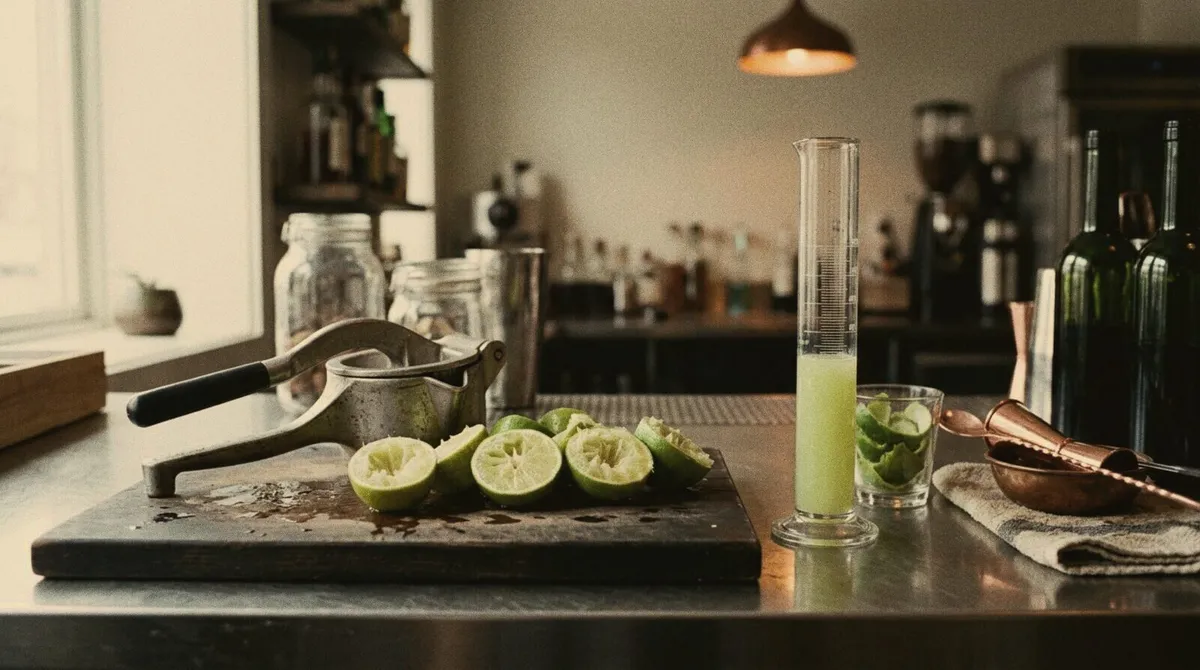
Look at the lime juice: you do not pay per millilitre of juice, you pay per kilo of fruit. The yield (here, 400 ml of juice per kilo) is what turns the price of the case into a real cost per millilitre. The same goes for any citrus, herb or fruit.
Add the waste
Let’s assume 5% waste across spillage, product you cannot use and drinks sent back (an example figure; you need to measure your own).
- Cost with waste = 2.19 ÷ (1 − 0.05) = 2.19 ÷ 0.95 = €2.31 (rounded).
Work out the price
As an example, let’s set a target cost of 25% of the selling price before VAT. This is not a recommendation: every bar concept has its own.
- Price before VAT = 2.31 ÷ 0.25 = €9.24.
- Let’s assume 10% VAT for the example only (confirm with your accountant the rate that applies to you): 9.24 × 1.10 = €10.16.
- Menu price, rounded: €10.00.
Check the real result
Rounding to €10.00 changes the calculation, so you need to check it again:
- Real price before VAT = 10.00 ÷ 1.10 = €9.09.
- Real cost percentage = 2.31 ÷ 9.09 = 25.4%.
- Gross margin per drink = 9.09 − 2.31 = €6.78.
This last step is the one people skip most. If you round down to look generous, every drink costs you margin. If you round up, you gain margin but may slow down how fast the drink sells. Decide knowing what you are deciding.
How to cost well: mistakes I see again and again
Making the sheet is easy. Making it well takes discipline:
- Not updating prices. A supplier puts the rum up 8% and your star drink goes from profitable to a favour to the guest.
- Measuring by eye. The costing assumes 50 ml. If the team pours 60, your real margin is different. Always use a jigger.
- Forgetting the preps. A house syrup, cordial or infusion also needs its own costing, with its yield and its shelf life.
- Mixing pack sizes. If you buy the same gin in 70 cl and 1 litre bottles, the cost per millilitre changes.
- Costing only the menu. Off-menu drinks, daily specials and event cocktails also use up product.
Theoretical cost versus actual usage
The sheet gives you the cost each drink should have. The stocktake tells you what it actually cost. The gap between the two is where the money leaks out.
An example, again for illustration: if in one week you sell 56 drinks with 50 ml of rum, theoretical usage is 56 × 50 = 2,800 ml, that is, 4 bottles of 700 ml. If the stocktake (opening stock + purchases − closing stock) says 4.5 bottles went out, the variance is half a bottle: 0.5 ÷ 4 = 12.5% above what was expected.
That variance can come from spillage, unrecorded comps, recipes that are not followed, till errors or simply a sheet that was out of date. It does not tell you the cause, but it tells you where to look. If you want to go beyond manual calculations, Miselup recalculates costs and compares theoretical cost with actual usage without spreadsheets; and if you are comparing options, I explain what to ask of bar inventory software.
Costing template: which columns you need
If you build your own spreadsheet, these are the columns that cannot be missing:
| Column | What it is for |
|---|---|
| Ingredient | Exact name, with brand and pack size |
| Purchase price | What you pay per pack, net of VAT |
| Usable content | Millilitres or units you really use |
| Yield | Usable percentage (citrus, fruit, herbs) |
| Unit cost | Price ÷ usable content |
| Quantity in recipe | The exact millilitres on the spec |
| Cost in the drink | Unit cost × quantity |
| Waste | Measured percentage, not assumed |
| Menu price | With and without VAT |
| Gross margin | In euros and as a percentage |
With a sheet like this you can start today. When you handle lots of recipes, house preps and prices that change every week, keeping it by hand turns into a job in itself.
How costing fits with your cocktail menu
Costing does not decide the menu, but it shapes it. A drink with a 40% cost is not necessarily a bad one: it may be the one that draws the guest in. What you cannot afford is not knowing it. With the sheets done you can balance the menu (a few drinks to bring people in, others with a high margin) and spot which ones are worth reworking. If you are at that point, I explain how to approach it in how to design a cocktail menu.
When it makes sense to ask for help
Costing one drink is simple. Reviewing every sheet on a menu, finding where margin leaks and fixing it without breaking the identity of the bar is a different job. In bar audit and cost control I review your sheets, your purchasing and your actual usage, and leave you with a system your team can keep running without me.
Topics: cocktail costing · bar costs · drink pricing · bar profit margin
Frequently asked questions
How do you calculate beverage cost?
Add up the cost of every ingredient in the exact quantity the drink uses, including ice, garnish and waste. Then divide that cost by the selling price before VAT. The result is your cost percentage. Keep every figure net of VAT, or the percentage will be wrong.
What is a costing sheet in a bar?
It is the sheet that works out what it costs to produce one unit for sale (a dish, a drink) by adding the cost of each ingredient in the exact quantity used. You use it to set the selling price and keep an eye on the margin.
What types of costing sheet are there?
Behind the bar there are two levels. The first is the costing of your prep (a syrup, a cordial, an infusion), which gives you the cost per litre of what you make. The second is the costing of the finished drink, which uses that cost as one more ingredient. In kitchens you also see yield costing, which measures how much of a product is usable once it has been trimmed or butchered.
What is a good pour cost for a cocktail?
There is no universal number: it depends on the concept, the venue and the drink category. The usual approach is to set a target per category and review it every quarter against real data. In this article I use 25% purely as an example for the calculation.
How often should you update a costing sheet?
Every time a supplier changes a price, the recipe changes or the pack size changes, and at least once a quarter. A costing sheet nobody reviews is an old photograph of your margin.
Should costing include VAT?
Record purchase costs net of VAT and calculate the target price net of VAT too. Add the tax at the end to get the menu price. If you mix amounts with and without VAT on the same sheet, the cost percentage comes out distorted.
Want to bring this to your bar?
Bar audit and cost control
I come to your bar during live service, review your menu, costings and waste, and leave you a prioritised 90-day plan.
Miselup
Recipe costing, costs, stock and prep sheets for your bar.