Cocktail Spec Sheets: Make Every Drink Taste the Same
How to write cocktail spec sheets that standardise your bar: the fields to include, how to train your team with them and how to keep them up to date.

Cocktail spec sheets are the cheapest way to make sure the same drink comes out the same, whoever makes it. If your Negroni tastes different on a Friday night than on a Tuesday afternoon, you don’t have a talent problem: you have a system problem.
In this article I explain what a spec sheet should contain, how to use it to train a team and how to stop it turning into a forgotten PDF. I’m writing from behind the bar, not from a textbook.
Why standardising your recipes changes the business
When a bar isn’t standardised, every bartender adjusts “by eye”. With good intentions, but with consequences:
- The guest doesn’t get what they ordered. And if they come back, they don’t know which drink they’ll find.
- Costs drift. A little extra in every serve turns into bottles by the end of the month.
- Training is slow. The new starter learns from whoever is next to them, bad habits included.
- You can’t scale. With no written recipe, the knowledge lives in the heads of two people. If they leave, the menu leaves with them.
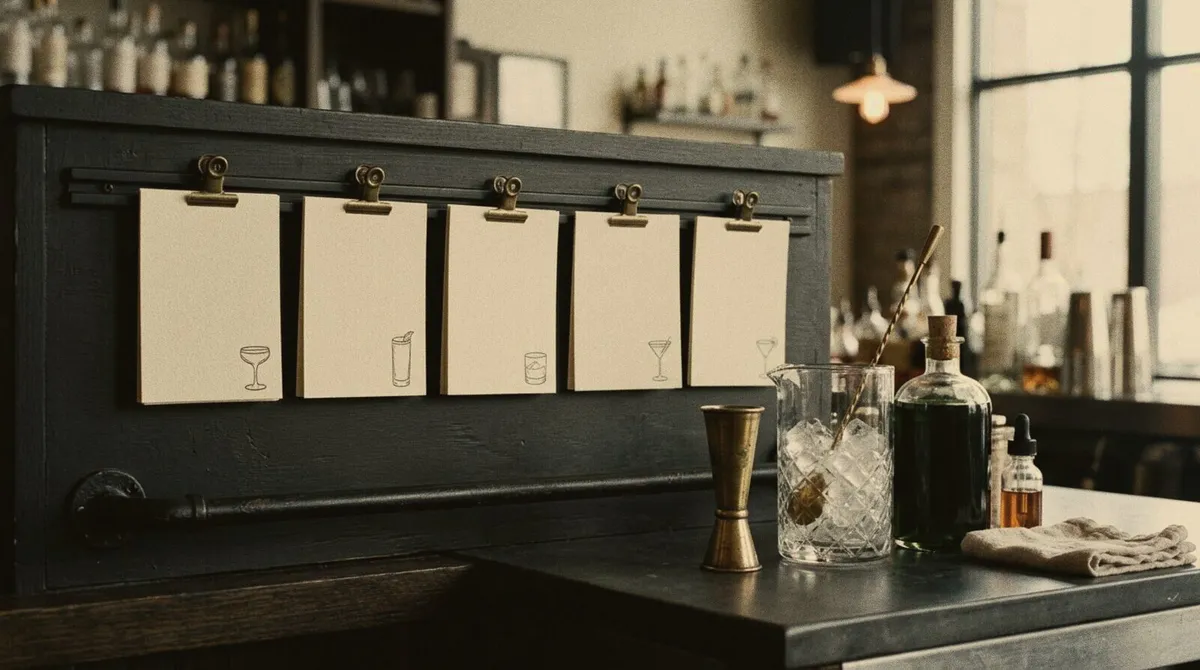
Standardising doesn’t kill creativity. Quite the opposite: it sets the foundation so that creativity shows where it should, in the new menu and in how you look after the guest, and not in improvising measures.
What a cocktail spec sheet should include
A good spec sheet fits on one page and can be read in ten seconds with wet hands. These are the fields I wouldn’t negotiate on:
| Field | What to note | Why it matters |
|---|---|---|
| Name and version | Cocktail name, date and version number | Stops two different sheets going round |
| Ingredients and quantities | Exact brand or product, in ml or grams | It is the basis of consistency and of cost |
| House preparations | A link or reference to their own spec sheet | A cordial or an infusion needs standardising too |
| Method | Technique (shaken, stirred, built…), order of steps, timings | It changes the dilution and the texture |
| Ice and glassware | Type of ice, glass, whether it is chilled | It is half the experience of the drink |
| Garnish | What goes on it and how it is cut or placed | What the guest sees first |
| Allergens | Those it contains or may contain | Key information for guest safety and for service |
| Cost and price | Cost per cocktail and selling price | Tells you what margin it leaves |
| Photo | An image of the correct serve | The “this is how it should look” without words |
Two important points:
- Always measured quantities. If the spec says “a little bit of” or “a generous dash”, it isn’t a spec sheet, it’s a suggestion.
- Specific brands. Swapping one product for another changes flavour and cost. If you substitute, you update the sheet.
An example of the structure (made up, only to illustrate)
This is a generic outline, not any bar’s recipe:
| Field | Example entry |
|---|---|
| Cocktail | “Example cocktail” · v1.2 |
| Ingredients | 50 ml spirit A · 20 ml house cordial · 15 ml juice |
| Method | Shake with ice and double strain |
| Glass | Chilled coupe |
| Garnish | Citrus twist, not touching the rim |
| Allergens | To be completed according to the ingredients |
| Cost per cocktail | Calculated with your costing sheet |
The numbers come from your own costing, with your suppliers’ prices.
How to use spec sheets to train your team
A spec sheet without a training process is just paper. With a process, it’s the best induction manual you can have.
- Explain the why before the how. A team follows what it understands: why that dilution, why that glass.
- Make the drink in front of them with the sheet in your hand. You first, then them, while you watch.
- Have them make the same cocktail several times. Ideally you compare across several people: same weight, same volume, same presentation.
- Taste and correct as a group. No blame: the aim is for the system to work.
- Assess before leaving them alone on service. A short practical test for each cocktail on the menu.
At Stillroom Academy, where I run the courses, we work in groups of no more than eight students precisely so that we can correct each person’s technique. That small-group, repeated-practice logic is the same one I recommend behind a bar: few people, a clear spec sheet and close follow-up. If you want to train your team with that method, I work on it in bar staff training. And if you are the one who is going to lead that bar, you’ll want to read from bartender to head bartender.

Where to keep your spec sheets so they get used
The best spec sheet is the one within arm’s reach. There are three common formats:
| Format | Advantages | Drawbacks |
|---|---|---|
| Laminated paper on the bar | Can be checked without stopping work, needs no screen | Hard to keep every copy up to date |
| Shared spreadsheet | Free, easy to edit, good for getting started | Gets duplicated and messy; the cost doesn’t update itself |
| Management app | A single version, links recipe, cost and allergens | Needs setting up and the team has to adopt it |
There is no one right format for everyone. For a small bar, paper and a well-kept spreadsheet may be enough. When the menu grows, staff turn over or you want the cost to recalculate when suppliers raise prices, a tool that links spec sheets and costs saves a lot of manual work. That is what Miselup does: management software for hospitality, which I distribute, that connects spec sheets, allergens and costing. If what you need is to work out the cost first, the article on cocktail costing can help.
Common mistakes when creating spec sheets
- Copying spec sheets from the internet. Another bar’s template doesn’t reflect your brands, your ice or your costs. Use it as a skeleton, not as content.
- Leaving it until there’s time. When you have no spec sheet, you have as many versions as you have bartenders.
- Leaving out house preparations. If the cordial has no spec sheet, the cocktail isn’t standardised, however well the cocktail’s own sheet is written.
- Spec sheets with no owner. Someone has to be responsible for the current version and for pulling the old ones.
- Spec sheets nobody reviews after a supplier change. A change of brand with no update leaves you with a spec sheet that is wrong.
How to keep your spec sheets alive
Make maintenance a routine, not a project:
- Review every spec sheet at each menu change.
- One person responsible for versions and for withdrawing the obsolete ones.
- A change log: what was modified, when and why.
- Every new team member tests the spec sheet: if they find a fault, they note it down.
A spec sheet that gets corrected is a living spec sheet. And a bar with living spec sheets shows in the glass and in the books.
Spec sheets for each type of service
Not every cocktail is standardised in the same way. The spec sheet should reflect the reality of each service:
- Classic cocktails. Precision rules here: measures, dilution and temperature. A five-millilitre variation shows.
- Signature cocktails. As well as the recipe, the spec sheet should capture the house preparations and their method, because that is where the identity of the menu lies.
- Zero-proof cocktails. They deserve the same spec sheet as the rest; if they are made “by eye”, the section loses credibility (I explain this in the zero-proof cocktail menu article).
- Events and high-volume service. The spec sheet includes the batch or jug version, with the quantity made at one time and how it is kept (more in batching cocktails for bars).
When you standardise a menu, it pays to start by splitting it into these groups. That shows you straight away where the result is most likely to vary from one person to another, and that is where you put the effort first. At Stillroom, where I run the creative side of the bar, the lab and the house preparations are in plain sight: what is prepared before service matters as much as the service. That idea carries over to any bar.
How to start this week
If your bar has no spec sheets today, you don’t need a big project. This simple sequence gets you moving fast:
- List every cocktail on the menu and rank them by sales.
- Pick the five best sellers and write their spec sheets with the real measures used today.
- Make each one with the sheet in front of you and check that it tastes and looks as it should.
- Correct the sheet, not the glass: if the sheet doesn’t work, fix the sheet.
- Print it, laminate it or upload it to the tool you use, and withdraw any earlier version.
- Repeat with the next group of five until the whole menu is covered.
In a short time you go from “everyone does it their own way” to a system anyone can learn, and which also gives you the basis for working out costs with real data.
And if you want help setting it up
Standardising a bar isn’t about handing out templates; it’s about deciding what gets measured, who is responsible for what and how the team is trained so that it sustains itself. If you’d like us to go through your spec sheets, your costs or your team’s training together, tell me how your bar works through the contact page and we’ll see where to start.
Topics: cocktail spec sheets · standardise recipes · bar staff training · bar management
Frequently asked questions
What is a cocktail spec sheet?
It is the one-page document that defines how a cocktail is made and served in your bar: exact ingredients and measures, method, glassware, ice, garnish, allergens and cost. Its job is to let any member of the team make the drink the same way.
What is the difference between a spec sheet and recipe costing?
The spec sheet explains how the drink is made; the costing works out what it costs and how much margin it leaves. Ideally they share the same data, so that when the recipe changes on the spec sheet, the cost is recalculated.
How many cocktails need a spec sheet?
Every drink on the menu, no exceptions, plus the house preparations (cordials, infusions, base mixes) that several cocktails use. Start with your best sellers and finish the rest within a few weeks.
Who should write the spec sheets for a bar?
Whoever designs the menu or the head bartender writes them, but the team who will use them signs them off: if a bartender doesn't understand a step, the spec sheet isn't finished. What matters is that one person is responsible for approving each version.
Can a spec sheet help with allergen information?
It is the best starting point. In Spain, Royal Decree 126/2015 allows allergen information to be given verbally, as long as it is also recorded in writing or in electronic format on the premises; one spec sheet per cocktail, including the house preparations, covers that record. Check with your food safety adviser how it applies in your case.
Want to bring this to your bar?
Bar staff training
I train your team in your own bar: your menu, technique, service standards, selling and product knowledge.
Bar audit and cost control
I come to your bar during live service, review your menu, costings and waste, and leave you a prioritised 90-day plan.